Designing the Future
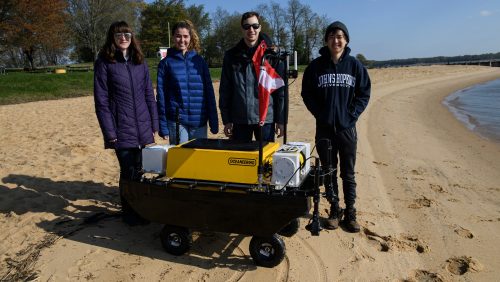
More than 1,200 have gone through the Department of Mechanical Engineering’s capstone Senior Design program since its founding in 1984. Each year, industry sponsors’ cutting-edge projects motivate and excite our students to explore the challenges of design engineering in the real world.
Our sponsors provide student teams with funds for materials, access to world-class resources, and technical contacts; and the students provide sponsors with functioning prototypes that have gone through the design loop several times and have been tested at the clients’ facilities.
Project Themes
-

Medical Devices & Systems
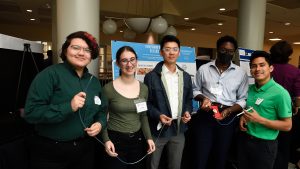
Projects challenge students to solve important clinical needs through the development of translatable medical devices and systems. Past projects include, for example, working on the design of a biopsy forceps that will help diagnose bile duct cancers.
-
Industrial, Safety, and Military Equipment
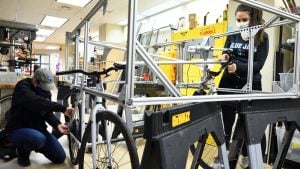
Students build new technologies to enhance safety and productivity while optimizing performance. Projects have included safety mechanisms to reduce lawnmower injuries to children and a new system to keep EMTs safer during transport calls.
-
Environment & Space
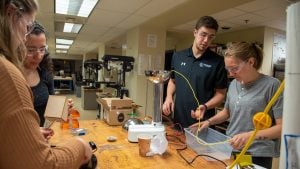
Students apply their engineering skills to projects that will help explore and improve our environment, from the ocean floor to outer space. Recent projects include a prototype that will allow researchers to collect and analyze space dust from the high atmosphere.
-
Community Outreach
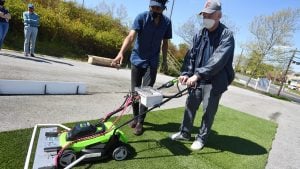
Seniors use their engineering knowledge and skills to serve nonprofit and community organizations. Projects in this area include designing adaptive technology to allow blind individuals to mow their lawns more safely.
Past Senior Design Projects
See our Design Day Brochures from our previous events to have an insider's look at the amazing projects our students create.
““While working with my Senior Design team, I was able to truly dive into the engineering process and gain experience I was not able to in any other class. From designing, rapid prototyping, manufacturing, testing to presenting, and communicating with sponsors—the amount of work that is directly applicable to industry is significant. I feel fully prepared to apply everything I have learned and continue to build upon this experience for the remainder of my career.” ”
Why Sponsor?
Our Senior Design program has a strong history of collaboration with sponsors from a range of disciplines across industry, government, academia, and nonprofit. Sponsors provide an open-ended problem and our students take the project through the design process to deliver their client an inventive, tangible solution. Projects that sponsors may not have the time or resources to pursue become the top priority of a team of Hopkins engineers.
Sponsors continually tell us that the Senior Design experience gives a solid return on their investment. Sponsors are exposed to the fresh perspectives and creative thinking of the very best undergraduate engineers—and Hopkins faculty—and a talent pool of potential employees.
The capstone Senior Design experience allows students to develop skills and apply concepts that are valued by employers. In return, sponsors get the opportunity to connect with the next generation of leaders in innovation and engineering design. It is a win-win for all involved.
““As the largest employer of individuals who are blind in Maryland, our organization often faces barriers around accessibility. To overcome these obstacles, we partner with Senior Design students to create inclusive solutions. It’s exciting to support and mentor the next generation of engineers and leaders as they develop a product that aligns with our mission. Our goal is that after working with us, Senior Design students enter the field with the understanding and tools to critically consider the diversity of their end-users while positively shifting the landscape of accessibility.” ”
Become a Sponsor
Are you Interested in learning more about being a Design Day sponsor? Get in touch!
Stephen Belkoff
Projects with Purpose
Senior Design requires students to draw upon the four years of knowledge and experience they’ve gained in their engineering studies and put it to practical use. Here’s a sampling of the unique projects our students have worked on:
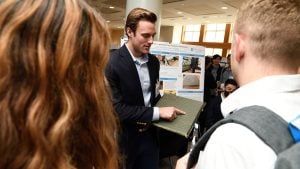
Next-Generation Helicopters - In collaboration with the Office of the Undersecretary of Defense, Senior Design students developed a strong but light floor panel for military helicopters.
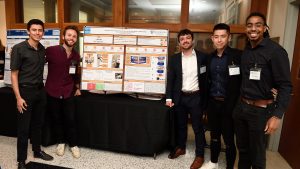
Fire Safety Innovation - Working with researchers at the the Johns Hopkins Center for Injury Research and Policy, Senior Design students developed a device that allows smoke detectors to be installed without using a ladder. This decreases the risk of injury while allowing for quick and easy installation of smoke detectors that save lives.
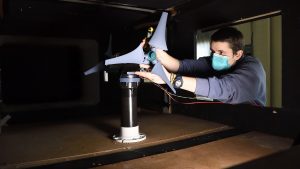
Making Wind Energy - Students designed and built a miniature dual-rotor, counter-rotating wind turbine capable of harvesting more energy from wind in a smaller space. Their design competed in the U.S. Department of Energy’s Collegiate Wind Competition, where they took home second place. Watch this video about their project.
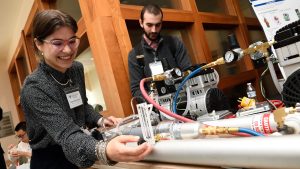
Oxygen Concentrator for Low-Resource Settings - Oxygen therapy through oxygen tanks is the most common treatment for COVID-19, however oxygen tanks have become scarce in low-resource settings. But there is another option: oxygen concentrators. Mechanical Engineering seniors worked with Prime Manufacturing to create an oxygen concentrator for low-resource settings.
Juniors, Prepare for Senior Design!
Though the course is called “Senior Design,” the preparation work begins in the Junior year. Here’s how to prepare: